


BJJ vs wrestling is one of the most debated matchups in all of grappling — and for good reason. Both arts have produced world-class fighters, real-world self-defense success stories, and some of the most technically gifted athletes in combat sports.
The honest answer is that the “better” art depends entirely on what you’re training for. In this article we break down how these two grappling systems compare across the scenarios that actually matter: self-defense, MMA, street fights, and training for kids.
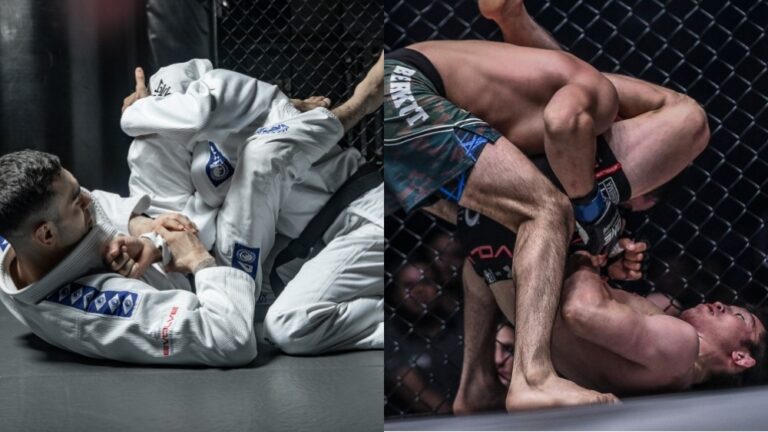
BJJ vs Wrestling — What Are the Main Differences?
History and Origins
Brazilian Jiu-Jitsu traces its roots to the early 20th century, when Mitsuyo Maeda — a Japanese judoka — emigrated to Brazil and began teaching ground fighting to the Gracie family. Carlos and Hélio Gracie refined those techniques into a system built around leverage, submissions, and the ability of a smaller person to neutralise a larger one. The Gracie Challenge fights of the 1920s and 30s, and later Royce Gracie’s dominance in the early UFC, put BJJ on the global map.
Wrestling is one of the oldest martial arts in recorded history. Cave drawings in France dating back 15,000 years depict grappling, and wrestling was a centrepiece of the ancient Greek Olympics. The Western folkstyle and freestyle systems that dominate American high school and college programs evolved from these ancient roots into a highly athletic, takedown-focused discipline.
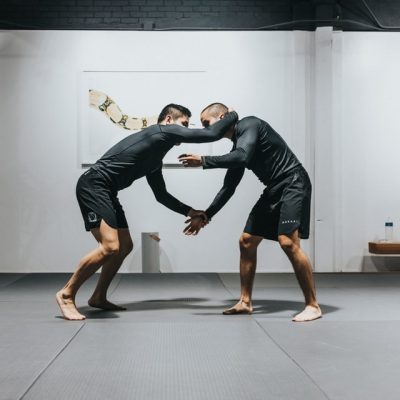
Techniques and Emphasis
BJJ | Wrestling | |
Primary goal | Submission or positional control | Takedown and top control |
Key moves | Guard, sweeps, chokes, joint locks | Single leg, double leg, sprawl |
Ground game | Extensive — the entire game | Limited — pin-focused |
Finishing ability | High — submissions end fights | Low — control without finish |
Competition focus | Points, submissions, time | Takedowns, exposure, pins |
Key BJJ techniques:
- Guard (closed, open, half guard)
- Triangle choke, rear naked choke, guillotine
- Armbar, kimura, omoplata
- Sweeps and positional escapes
Key wrestling techniques:
- Single leg and double leg takedowns
- Sprawl and front headlock
- Cradle, tilt, and pin combinations
- Snap downs and scrambles
In our experience on the mat, the biggest adjustment going from wrestling to BJJ is learning to fight effectively off your back. Wrestlers are conditioned to treat the bottom position as a loss — in BJJ, it’s where some of the best offense lives.
Jocko Willink has explained what the differences between Wrestling and BJJ in youtube. Check it out below.
BJJ vs Wrestling for Self-Defense — Which Is Better?
Verdict: BJJ.
For most real-world self-defense scenarios, BJJ gives you more tools to actually end a confrontation. Wrestling will get you the takedown — but then what? If you’re on top of someone and can’t finish, you’re in a prolonged grappling match on the ground with no clear resolution.
BJJ trains you to finish. A rear naked choke or armbar applied correctly ends the situation without you throwing a punch. More importantly, BJJ’s emphasis on leverage means it genuinely works against larger, stronger opponents, which is exactly the scenario self-defense needs to address.
Having rolled with wrestlers for years, I’ll say this: a trained wrestler’s takedown is absolutely brutal. A well-executed double leg to a slam on pavement is a fight-ender in its own right. Wrestling’s explosive power and takedown ability should never be underestimated in a real confrontation.
The difference is that BJJ gives you an off-switch. Wrestling gives you control, but control alone doesn’t end a street fight.
That said, no grappling art is perfect for self-defense in isolation. Both assume a one-on-one scenario on relatively flat ground. If you’re thinking seriously about self-defense, check out our guide to BJJ for beginners for a clear starting point.
BJJ vs Wrestling for MMA — Which Is More Effective?
Verdict: Both are essential, but wrestling has the structural edge.
Modern MMA is not a single-art game. The fighters who dominate in 2026 are those who can dictate where the fight happens — and that is wrestling’s greatest gift. A wrestler chooses whether the fight stays standing or goes to the ground. In a sport governed by unified rules that reward takedowns and top control, that decision-making power is enormous.
The statistics reflect this reality. A significant proportion of UFC champions across weight classes have come from wrestling backgrounds — athletes like Khabib Nurmagomedov, Daniel Cormier, and Henry Cejudo built their game on takedown dominance and positional control from top. UFC.com’s fighter database consistently reflects the depth of wrestling pedigree at championship level.
BJJ’s contribution to MMA is equally undeniable, and just different. Royce Gracie’s early UFC dominance in the 1990s proved that ground fighting and submissions could defeat bigger, stronger strikers. Today, BJJ provides submission finishing ability, guard work to survive from the bottom, and the submission defense needed to stay safe when taken down.
- Wrestling’s MMA edge: controls fight location, top pressure, cage work, cardio base
- BJJ’s MMA edge: submission finishing, guard recovery, submission defense, transitions
For fighters training no-gi, the crossover between the two arts becomes even more pronounced. Our breakdown of no-gi BJJ covers how the ruleset shifts the dynamic toward wrestling-influenced grappling.

BJJ vs Wrestling in a Street Fight — Who Wins?
Verdict: BJJ edges it — but context matters.
The street fight scenario is where technique meets chaos, and BJJ has one key advantage that wrestling doesn’t: it trains finishing. A wrestler shooting a double leg on pavement leaves their neck exposed. After years of drilling the guillotine choke, a trained BJJ player will recognise that opening instantly.
Wrestling’s counters are genuinely dangerous in an uncontrolled environment. A slam on concrete is not a controlled takedown — it can cause serious injury. That raw power is something no BJJ practitioner should dismiss.
The major caveat for BJJ is multiple attackers. Ground fighting against more than one person is extremely dangerous, and BJJ’s ground-centric game becomes a liability if a second person enters the fight. In that scenario, wrestling’s standup scrambling and ability to stay on your feet is actually the more pragmatic skill set.
Practically speaking, the best street self-defense art combines both: wrestling’s ability to stay upright and control space, with BJJ’s ability to finish cleanly if it does go to the ground.

Can You Train Both Wrestling and BJJ?
Yes, and if you’re serious about grappling, it’s the ideal combination.
Wrestling and BJJ complement each other almost perfectly. Wrestlers who add BJJ gain what they’ve always been missing: finishing ability. A wrestler who can submit opponents becomes exponentially more dangerous, because opponents can no longer simply wait out top control. BJJ players who cross-train wrestling gain takedown explosiveness and the positional aggression to get fights where they want them.
The practical advice we give to anyone asking about cross-training: build a solid base in one art first — at least 12 to 18 months of consistent training before adding the second. Trying to absorb both simultaneously from day one tends to produce a student who is mediocre at both rather than competent in either.
If you’re still deciding where to start your grappling journey, our MMA training guide breaks down how different grappling bases feed into a complete fighting game.
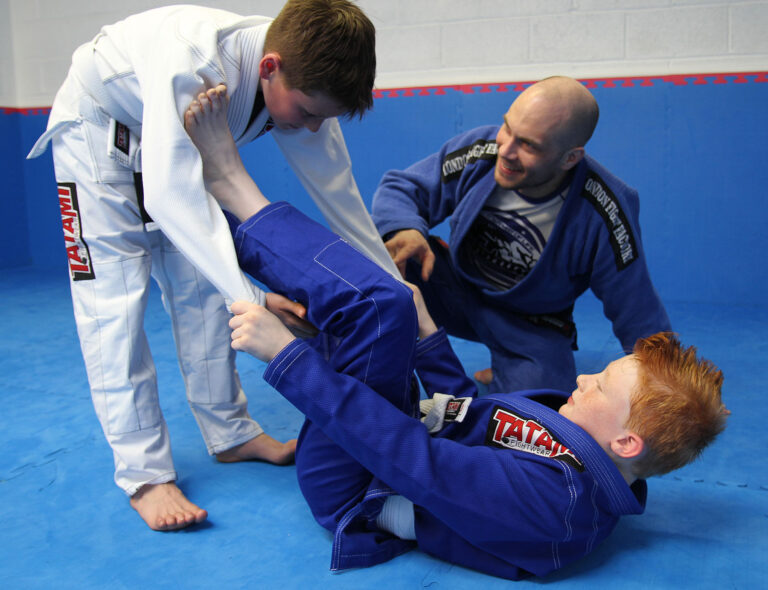
BJJ or Wrestling for Kids — Which Is Better?
Both are excellent choices, and both are safer than most striking arts for young athletes.
BJJ for kids has grown enormously as a youth sport over the past decade. Classes are widely available, run at virtually every age group, and the culture tends to be inclusive regardless of athletic background. It’s a sport a child can train for life — there’s no age ceiling. Competitions are accessible and typically well-organised for younger athletes through organisations like the IBJJF. You can read more about gear and getting started in our best BJJ gis for beginners guide.
Wrestling for kids has one structural advantage BJJ can’t match: school infrastructure. In the US especially, wrestling programs exist at middle school and high school level in almost every state, meaning kids can train as part of their academic schedule and compete in a highly organised national system. For a young athlete with competitive ambitions, the pathway through scholastic wrestling to collegiate and even Olympic competition is clear and well-supported.
Our honest recommendation for parents:
- If your child is under 10: BJJ tends to be the more accessible starting point
- If your child is in middle or high school: wrestling via the school program is an incredible opportunity
- Best of all: let them try both and follow what they enjoy — a kid who loves training will always outperform one who doesn’t
I do recommend my nephew to train BJJ nowadays. It allows them to enjoy the sport and enhance their body strength.
Conclusion: BJJ vs Wrestling : Which One Is Better Overall?
Here’s the honest verdict, broken down by what matters most:
Scenario | Winner | Reason |
Self-defense | BJJ | Finishing ability, leverage over size |
MMA | Wrestling (base) + BJJ (finish) | Controls fight location; submissions close it out |
Street fight | BJJ (slight edge) | Submission finishing; caveat for multiple attackers |
Cross-training | Both | They are better together than apart |
Kids / beginners | BJJ | More accessible; lifetime sport |
Competitive athletes | Wrestling | School infrastructure; athleticism development |
For most people reading this — adults considering grappling for fitness, self-defense, or general martial arts — BJJ is the better starting point. It’s more widely available, more technique-dependent (meaning size matters less), and builds a complete ground game that transfers well into every other grappling context.
For competitive fighters and serious MMA athletes, wrestling is the higher-percentage base — but the best grapplers in the world don’t choose between the two. They train both.
