

If you just bought your first gi, congratulations and also, pay attention to this part. How you wash your gi from the very first session has a direct impact on how long it lasts, how it fits, and whether your training partners want to roll with you.
I’ve seen brand new gis shrink two sizes after one hot wash. I’ve also trained with people whose gi smelled like a wet dog because they left it in their bag overnight. Both are avoidable mistakes and both start with not knowing how to wash a gi properly.
This guide covers everything: the first wash, ongoing care, what to avoid, and how to keep your gi in good condition for years of training.
**Still wonder which BJJ Gis you should buy as a beginner? Check out our article of “Best BJJ Gis for Beginners” and we have a full list for you.
Why the First Wash Matters
The first wash sets the tone for everything that follows. Most gis — especially 100% cotton ones — are prone to shrinking if they’re not washed correctly from the start. A gi that fits well off the rack can become unwearable after one careless wash cycle.
Beyond shrinkage, that first wash removes factory chemicals, sizing agents, and any residue from packaging. You want your gi clean before you wear it, not just before you wash it the second time.
Get the first wash right and you build a habit that protects your gear long-term. Get it wrong and you’re buying a new gi sooner than you planned.
Will My BJJ Gi Shrink When I Wash It?
The short answer: yes, it can — especially on the first wash. How much depends on the material.
- 100% cotton gis shrink the most. They’re traditional and durable, but cotton contracts when exposed to heat. The first few washes tend to cause the most shrinkage, which then levels off.
- Pearl weave and ripstop gis (often cotton-polyester blends) are more resistant to shrinkage. They’re lighter and hold their shape better across washes.
Pre-shrunk gis exist, but don’t fully trust that label. The safest approach for any gi regardless of material is **cold water** washing and **air drying** every single time. Heat is the enemy of a well-fitting gi.
Step-by-Step: Washing Your BJJ Gi for the First Time
Step ①: Turn the gi inside out before it goes anywhere near the machine.
This protects the outer weave and any patches or embroidery from the friction of the wash cycle.
Step ②: Set your machine to a cold water, gentle cycle.
Cold water is non-negotiable for the first wash — it stops the cotton fibres from contracting. Anything above 30°C risks shrinkage you can’t undo.
Step ③: Use a small amount of mild, non-biological detergent.
Heavy detergents with enzymes or bleach agents can break down cotton fibres over time. A gentle detergent cleans the gi without attacking the fabric.
Still not sure what detergents you should use? Check out our review of Best Detergents for BJJ Gis 2026
Step ④: Do not use fabric softener.
Fabric softener coats the fibres and reduces absorbency, which matters for a garment you’re sweating in constantly. It also traps odour over time rather than eliminating it.
Step ⑤: Wash the gi alone or only with other gis.
Gi patches, thick collars, and heavy weaves can damage lighter clothing. Keep your gi wash separate from your regular laundry.
Step ⑥: Remove the gi promptly when the cycle ends.
Leaving a wet gi sitting in the drum — even for an hour — allows bacteria and mildew to start developing. Pull it out and move straight to drying.
Step ⑦: Air dry the gi flat or on a wide hanger, away from direct sunlight.
Lay it flat on a drying rack to maintain the shape, or use a wide-shouldered hanger. **Direct sunlight** fades the fabric and can weaken cotton fibres over repeated exposure.
IMPORTANT NOTES: Never leave a wet gi in your bag. It’s the fastest way to ruin the fabric and grow bacteria.**
How to Dry a BJJ Gi Without Ruining It
The dryer is the single biggest threat to your gi’s lifespan and fit. The heat causes rapid, uneven shrinkage — and once a gi has been through a hot dryer cycle, there’s no recovering the size.
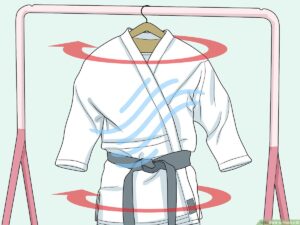
Always air dry. In warmer months, hang your gi indoors near an open window. In winter, a drying rack near a radiator works — just don’t hang the gi directly on the radiator itself. The contact heat is too concentrated and will damage the collar area specifically.
Budget extra drying time for thick gis. A heavy single or double weave gi can take 12–24 hours to fully dry indoors. That’s one of the strongest arguments for owning two gis — you’re never stuck with a damp one on training day.
Gi Care: Do’s and Don’ts
✅ Do | ❌ Don’t |
✅ Wash after every session | ❌ Leave wet gi in bag |
✅ Turn inside out | ❌ Use bleach or chlorine |
✅ Cold water only | ❌ Machine dry |
✅ Air dry indoors | ❌ Dry in direct sunlight |
✅ Rotate between multiple gis | ❌ Iron over logos or patches |
✅ Wash belt regularly | ❌ Lend gi to others |
How Often Should You Wash Your BJJ Gi?
After every single session, and no exceptions! This is non-negotiable in BJJ.
You’re on the mats for an hour or more, pressed against other people, working through sweat. Bacteria build up fast on gi fabric. Washing after every session isn’t just about hygiene for you — it’s about respecting your training partners.
Some people try to stretch a gi across two sessions, especially if they trained light. Don’t. Even a light session leaves enough bacteria on the fabric to cause problems. A fresh gi every time is a basic part of mat etiquette.
Can You Wash a BJJ Gi With Regular Clothes?
Technically yes, but it’s not ideal. Gi fabric — especially a thick weave — is heavy and bulky. It can throw off the balance of a wash load and may not get properly clean when crammed in with other items.
More practically, gi patches and heavy collars can snag lighter fabrics. Wash your gi separately, or group it only with other training gear like rash guards and shorts.
Dealing With Gi Odour That Won’t Go Away?
If your gi has developed a persistent smell that regular washing doesn’t fix, the bacteria have likely embedded into the fibres. A few things that genuinely help:
- White vinegar soak: Add a cup of white vinegar to a cold water soak before washing. Let the gi soak for 30–60 minutes, then wash as normal. Vinegar neutralises bacteria without damaging cotton.
- Baking soda in the wash: Add half a cup of baking soda directly to the drum alongside your detergent. It works as a deodoriser and helps lift embedded smells.
- Sunshine exposure (brief): A short period in indirect sunlight — not direct, prolonged sun — can help kill surface bacteria on a clean gi. Don’t make this a regular habit.
If none of these work, the gi may be past recovery. A gi that smells after washing is a gi that needs replacing.
Conclusion: How to Wash your BJJ Gi for First Time
The points above are the main essentials related to the first wash of your Gis. Washing it for the first time is not too hard; you just need to be careful with it. Buy from the brand you prefer; you can choose a color according to your preference. All you need to do is follow the rules of washing and caring according to the color, shape, and fabric so that you can use your Gi for a long time. Buy a perfect Gi, maintain it properly, that can show up your personality.
Looking for a new gi? Check out our roundup of the Best BJJ gis 2026 — with picks across every budget, available on Amazon.
FAQ: Washing a BJJ Gi
No. The heat causes shrinkage — often significant and permanent on cotton gis. Always air dry, flat or on a wide hanger, away from direct heat sources.
Cold water — 30°C or below. This is especially important for the first wash. Hot water causes cotton fibres to contract and your gi to shrink.
No. Bleach degrades cotton fibres, weakens the weave, and will yellow a white gi over time. Use a mild detergent only.
Anywhere from 8 to 24 hours depending on the weave weight and drying conditions. Thick single or double weave gis take longest. This is why owning two gis makes training life significantly easier.
Yes. Your belt picks up the same sweat and bacteria as your gi. Wash it regularly — cold water, air dry, same as the gi. The belt won’t lose its rank by washing it, regardless of what the old myth says.
Try a white vinegar pre-soak or add baking soda to the wash cycle. If the smell persists after multiple washes, the bacteria are too embedded in the fibres and the gi likely needs replacing.
